

Energize your game with precision and power. POWERPLAY focused on cone stacking and terminal navigation, testing our mechanical precision and strategic thinking.
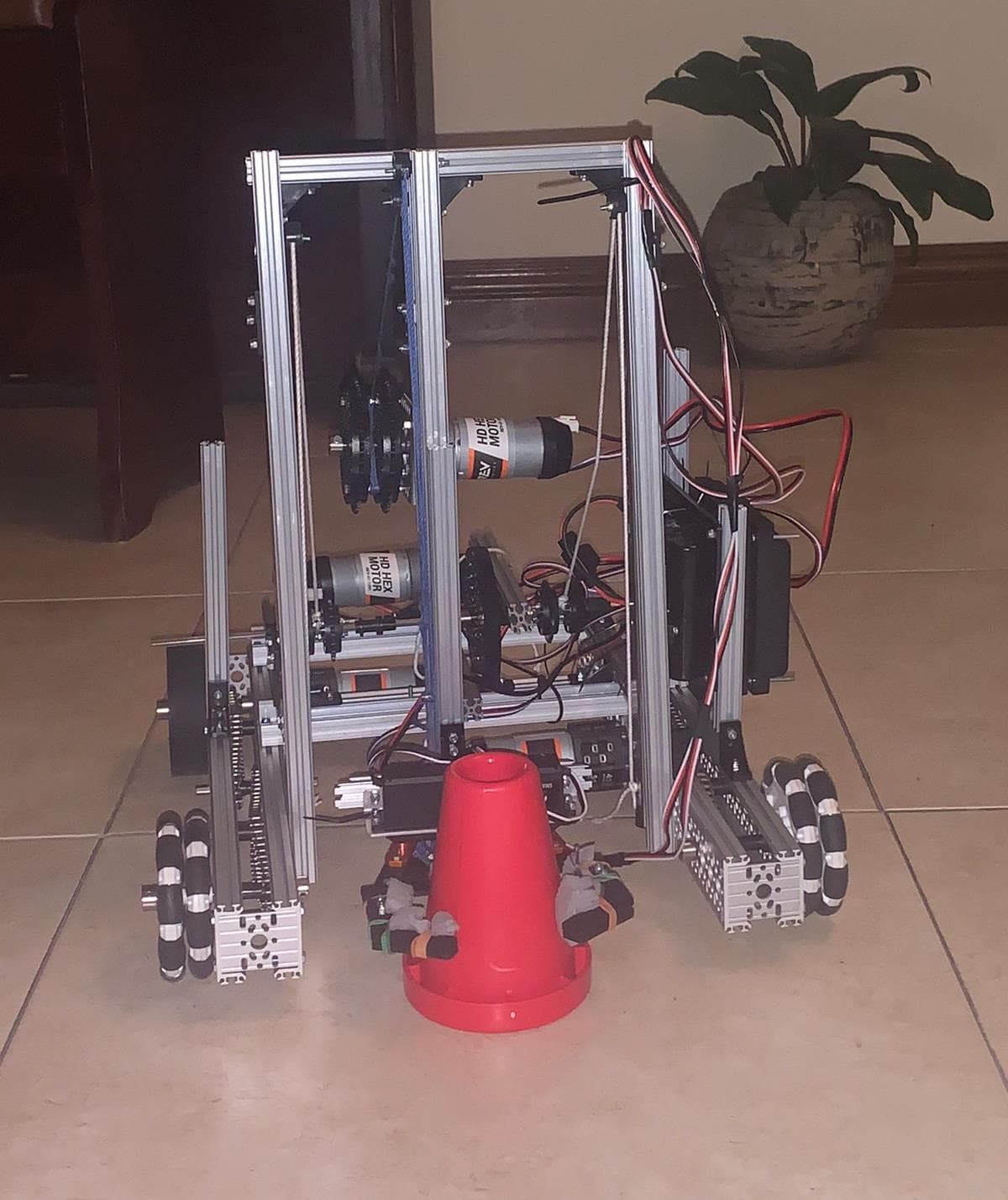
The team’s first FTC robot, built around a claw-and-vertical-slide scoring system on a modified starter-kit drivetrain. Nearly every subsystem went through multiple design iterations as the team learned core FTC engineering and fabrication skills for the first time.
Started as two traction and two omni wheels linked by roller chains, which proved bulky, unstable, and put excess pressure on the omni wheels. Realigning the wheels and moving the traction wheels to the back — with help from a mentor team — fixed the uneven driving and instability.
Iterated through drawer slides (fast, but only 0.28 m reach), then linear extrusion slides (0.6 m reach, but the least stable option), before settling on a combined drawer-and-linear-slide system reaching 1.1 m with far greater speed and stability.
Compared a double-extrusion gripper, a servo-and-gear gripper, and a final 2-servo design before settling on a hexagonal, multi-point-contact claw with foam padding to distribute grip force evenly and keep cones from slipping out.
Official competition records and public repositories are linked directly. Technical descriptions on this page are the team’s account of the robot.