
Decode

Every artifact we uncover holds a story. Each tool, each innovation, each work of art connects us to the people and ideas that came before us. Using STEM skills and teamwork, today we can dig deeper into discoveries than ever before.
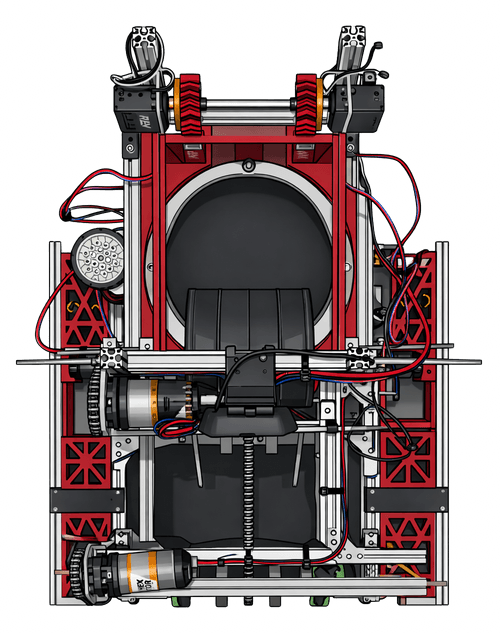
Sir Launch-a-lot is built around a three-stage scoring system — intake, transfer, and shooter — with each stage operating independently while working together under match pressure. A dual-stage intake with active centering feeds a high-torque transfer that only engages when needed, which in turn loads a turret-mounted hooded flywheel shooter capable of aiming independent of the drivetrain.
The mobility base that carries the intake, transfer, and shooter around the field, giving the turret a stable platform to aim from regardless of where the robot is positioned.
A first stage quickly collects artifacts from the field, then a second stage pushes them toward the transfer. A center chain conveyor keeps artifacts moving forward while vectored wheels on either side actively center them for a clean handoff.
An independently-powered, high-torque stage feeds artifacts from the intake into the shooter on demand. It replaced an earlier passive, gravity-fed "kicker" design once active control proved more repeatable under match conditions.
A turret-mounted hooded flywheel aims horizontally without needing to rotate the whole robot, while an adjustable hood angle controls the launch arc — combining for fast, repeatable scoring at any position on the field.
Official competition records and public repositories are linked directly. Technical descriptions on this page are the team’s account of the robot.